
DRAG KING:1975-2021
Matuschka, once 6', with a deep voice and masculine posture has frequently been mistaken for a man or a transvestite most of her life. Since the '70s she has taken photographs that portray an androgynous 'vibe'. After the artists' breast was removed in 1991, her ability to impersonate men was uncanny and she began to create a cast of characters, both male and female that interacted with one another.
Before PhotoShop, the artist combined her male and female self-portraits by printing two negatives on a single sheet of photographic paper. In the mid-nineties, with the help of Photoshop- the artist combined multiple images on one sheet. These new combinations were still printed on fiber-based paper in the darkroom after a negative had been generated.
In 2000, Matuschka embarked on a series which capitalized on an ability to perform various roles of gender and race projected on four characters. She has portrayed herself as a man with half open-shirt revealing bare (and breastless) chest. In other views, with makeup she becomes a dark-skinned woman or, a mustached Italian with swaggering posture. She also cast herself as a Latino gent and a 'blond bombshell' stereotype.
Through self-portraiture, costuming, gesture, and gaze, Matuschka dismantles traditional roles and reveals the tension between societal expectation and self-expression. These provocative images force audiences to re-examine their ideas of gendered and racialized traits, to explore the triumphs of self-presentation and the failures of self-embodiment. For Matuschka, this performance is itself a cabaret, a kind of theatre of identity in which we all must participate.

What Are You Looking At? 1994
Photographs offered from this gallery are shot on a variety of formats: 35 mm negative and slide film; 2 & 1/4 negative film; 2 & 1/4 color transparency film, and polaroids. Prints are produced on fiber based paper as Silver Gelatin Prints. Many are one of a kind.
Digital images are available in numerous sizes on a variety of papers.
Artifacts from this series include: Press, digital reproductions, Polaroids, contact sheets, proof prints and mock ups; the artists make-up kits (including mustaches, beards, wigs, and outfits); Exhibition invites and documentation, digital storage (CD’s).

Matuschka as "Guido" Self-Portrait, 2001

Mad Hatter Headshot, 1975

Scotch & Solitaire, 1975

The Mask is Magic, the Mirror Tragic, 1982

Mad Hatter Profile, 1975

Bow Tie, Gerard Malanga, 1977
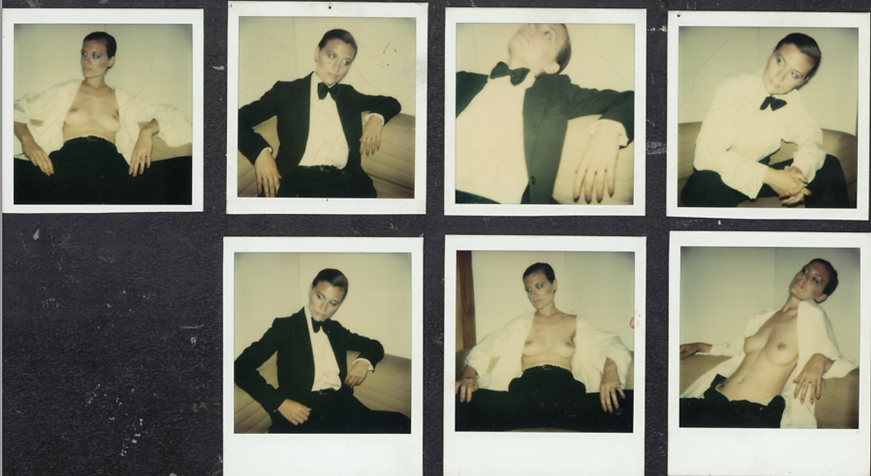
Photoshoot 1977
Gerard Malanga
Location: Matuschka's Apartment


Charlie Thinking, 1994
Little Boy Blue, 1992
Charlie (Legs Crossed), 1994


The Two of Us, 1994
The Four of Us, 1994
Arms Around You, 1994
Which Side Do You Want?, 1994

Mad Hatter with The Village Voice, 1975

Mens Room Back, 1989

Pakistan Man Thinking, 2001
Trading on stereotypes, she’s nevertheless quite convincing, so that by the time we have figured out the masquerade, we also realize we have been quite taken in by it."
– Joanne Leonard, Professor of Women's and Gender Studies, University of Michigan

Don't Globalize This, 2001


Matuschka as "Guido", 2001

Matuschka as "Blondie", 2001

Matuschka as "Maybelline", 2001

Matuschka as a Coal Miner #1, 2001

Matuschka as a Coal Miner #2, 2001

"Queer Flake Commercial" from the American Gothic series, Sarasota, Florida, 2021
Whether working with others, alone, or with an assistant, Matuschka is the author, director, make-up artist, hairstylist, wardrobe stylist, and printer of the pictures she creates.

Matuschka in Condo, Florida, 2021

Matuschka and Charlotte, 2021

Matuschka on Lania, 2021
PRESS


"Oscar Wilde said one can either make a masterpiece or be one. Artist Matuschka has managed to do both."
-Linda Vaccariello, Cincinnati Magazine, Ohio
“You have to wake people up to revolutionalize their way of identifying things. You’ve got to create images they won’t accept; make them foam at the mouth; force them to understand that they’re living in a pretty queer world. A world that’ s not reassuring. A world that that’s not what they think it is.”
-Andre Mairaux, Pablo Picasso Museum
Italian Strap & Tie, 1976, Italy

Matuschka, Tie & Strap, 1976